

A named governance boundary owned by an admin (approvals, wait timers, allowed refs, a required reason, concurrency, and scoped secrets), enforced at the point where it is used, in the engine.
What an Environment is
Section titled “What an Environment is”An Environment is a named governance boundary owned by an admin: staging, prod (ADR-0037). Its
value is not any single rule: one reference (environment: prod in a pipeline) pulls in a
governed bundle (approval + secrets + allowed refs + OIDC subject) defined once by an admin
and reused across pipelines. Because the rules live in an entity owned by an admin, not the pipeline
YAML, you get separation of duties: a pipeline author requests a deploy; the environment
governs it, regardless of what the YAML says. Editing an environment needs the Administer
capability on the repo.
Protection is optional per environment. An environment with no rules (typical staging) is a
frictionless label; it scopes secrets, nothing more. Add reviewers and it becomes gated. Same
entity, opt-in governance, so low-stakes targets pay nothing.
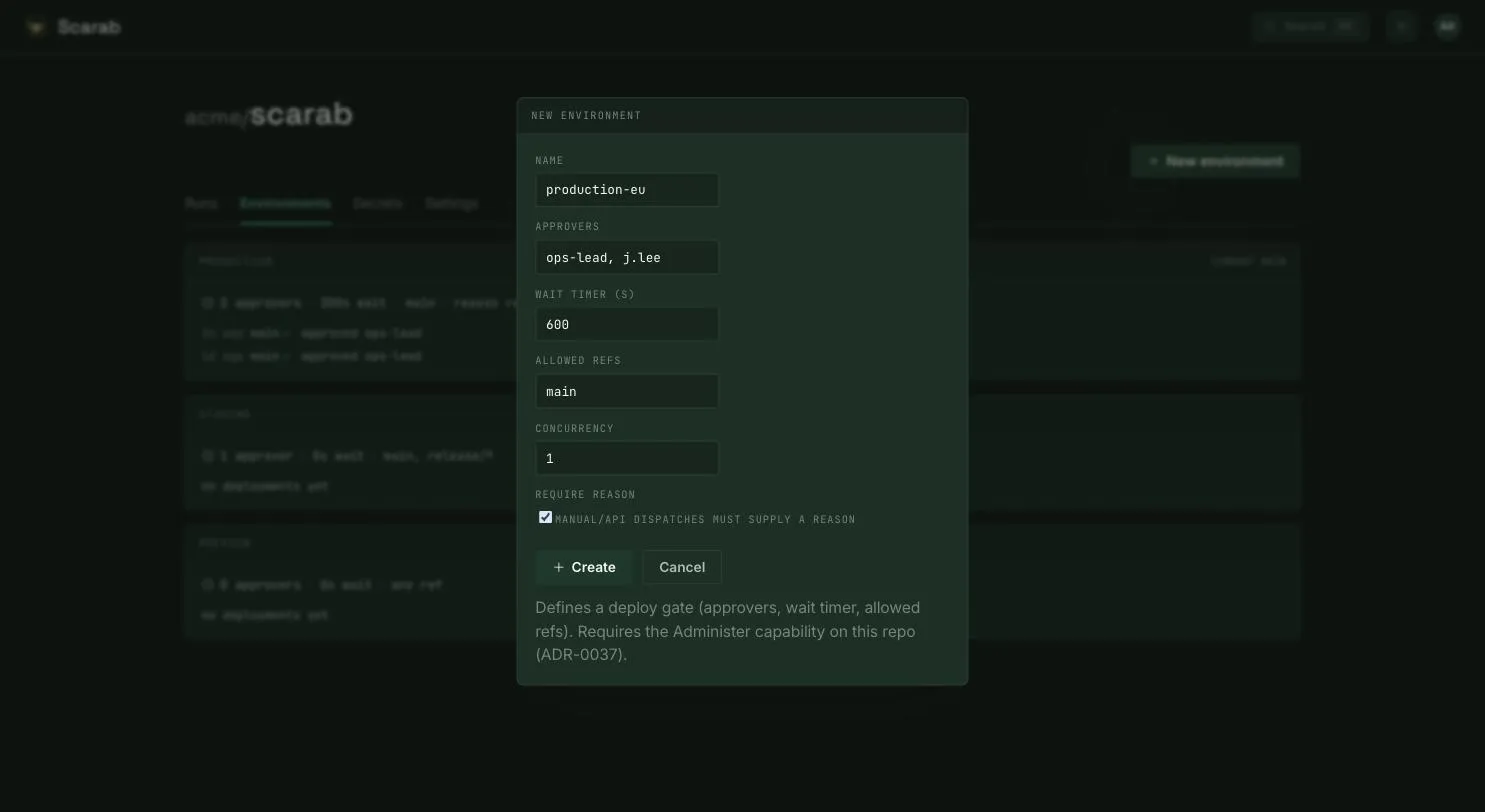
The governance it bundles
Section titled “The governance it bundles”An environment’s ProtectionRules carry:
approvers: principals whose approval is required. Approval is a gate, not a table: amanualgate in the run accumulates distinct approver identities on the run’s durable event log (GateApproved { step, by }), and the run stays suspended until every named approver has approved. Safe across restarts and unforgeable by construction.wait_timer: a mandatory wait (seconds) before a run may proceed.allowed_refs: glob patterns for the git refs allowed to deploy here; checked at run creation so a disallowed ref is rejected before any pod launches (blank = any ref).require_reason: a human dispatch (manual/api) into this environment must carry a reason (ADR-0057); push/PR/tag/release/cron are exempt.concurrency: the maximum concurrent deployments into this environment.
Two further governed knobs can be set only with Administer and fail closed: privileged_images (the
ADR-0039 privilege whitelist keyed by digest) and permit_k8s_overlay (the ADR-0055 raw pod-spec escape
hatch).
Scoped secrets with inheritance
Section titled “Scoped secrets with inheritance”An environment defines a secret scope. Steps in a run targeting it resolve keys through the
chain env → repo → org, where the most specific scope wins, so a value shared across environments lives once
at repo/org scope and only genuinely different values are stored per-environment. The scope is
canonical (the server stamps it from the environment’s (org, repo, name) coordinate), and prod
credentials therefore exist only under the gated environment and cannot be relocated by editing
pipeline YAML. See Secrets.
Admission at the point of use
Section titled “Admission at the point of use”Admission is enforced in the engine, not in a request body. allowed_refs is checked at run
creation; approvers is satisfied by the accumulated gate approvals on the run; require_reason
is checked at the admission gate. There is no approvals list supplied by the caller: the old standalone
POST …/deploy admission path is retired, and deployment history is read-only.
API surface
Section titled “API surface”Environments are managed under /v1/repos/{org}/{repo}/environments... (writes require
Administer):
| Method | Path | Purpose |
|---|---|---|
PUT |
/v1/repos/{org}/{repo}/environments/{name} |
Create or replace an environment + rules |
GET |
/v1/repos/{org}/{repo}/environments |
List a repo’s environments |
GET |
/v1/repos/{org}/{repo}/environments/{name} |
One environment’s protection rules |
DELETE |
/v1/repos/{org}/{repo}/environments/{name} |
Delete (idempotent) |
GET |
/v1/repos/{org}/{repo}/environments/{name}/deployments |
Deployment history (read-only) |
The surface is behind a feature gate: if the environment store is not configured, these endpoints return 404.